


Traditionally, a classroom has been seen as a confined space with a blackboard, a podium, and a projector. Teachers stood at the front, delivering lectures, while students sat neatly in rows, taking notes. This model, deeply rooted in educational systems for over a century, remained largely unchallenged until recently. With the rapid advancement of educational technology, this seemingly immutable structure is undergoing a subtle yet profound transformation.
By 2025, teaching spaces will no longer be limited to physical rooms. They are evolving into multidimensional ecosystems where people, devices, and content work in dynamic collaboration. The teaching and learning experience is no longer a one-way transmission, but a fluid, interactive environment that redefines the fundamentals of education. This shift is reshaping teacher-student relationships, instructional methods, and even the very design of school infrastructure.
Dissolving Classroom Boundaries: From Static Spaces to Dynamic Environments
The classroom, once defined by four walls and a door, has become permeable. Through live recording systems, remote collaboration devices, and smart e-boards, instruction now transcends physical space. With multi-screen interaction and video integration, teachers can teach simultaneously to local students and remote participants across campuses or virtual platforms.
Interactive displays are redefining the concept of the “lecture zone.” Traditionally, the blackboard and podium marked the instructor’s domain. Today, with triple-screen smart boards and mobile podium terminals, teachers can present from anywhere in the room. Wireless content casting to large displays, small devices, and student tablets has made the teaching focal point fluid and adaptive, centered not on place, but on interaction.
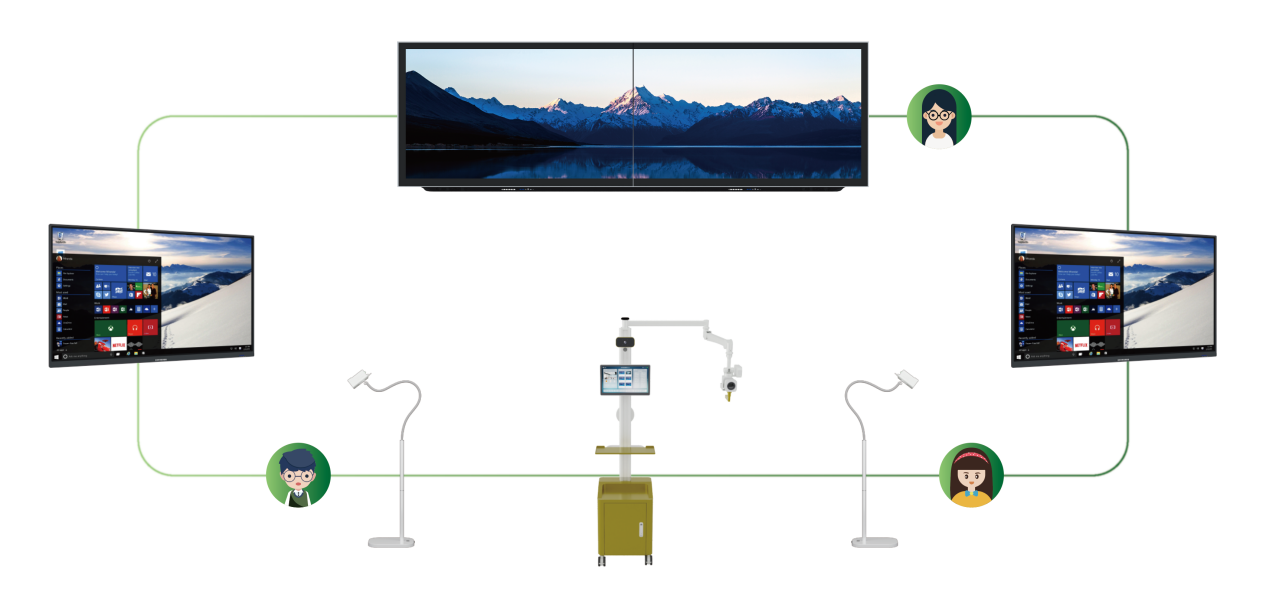
Shifting Teacher Behavior: From Stationary Presence to Spatial Mobility
In these transformed environments, teachers are no longer tied to a podium. Smart podium systems integrate control panels, touchscreens, wireless microphones, recording modules, and presentation remotes, enabling instructors to teach while moving, annotate on the go, and engage with content dynamically. Teaching becomes a spatially liberated act, no longer confined to fixed points.
This behavioral transformation goes beyond physical positioning—it reshapes pedagogical logic. Freed from the projector’s frame, teachers can prompt real-time questions, encourage spontaneous student participation, and use space more expressively, making instruction more flexible and compelling.
Reinventing Content Flow: From Static Slides to Real-Time Interaction
Content delivery has also evolved. Where once instruction relied on static PPTs, printed textbooks, and blackboard notes, today’s classrooms are equipped with interactive teaching software and smart devices that enable real-time collaboration:
- Teachers assign tasks via teaching systems, and students respond instantly on tablets or laptops.
- An annotation made on a shared image appears in real time on all student screens, where learners can interact and submit personalized responses.
- Teachers can insert instant quizzes or question cards mid-lesson, generating visual feedback across the classroom.
Moreover, content is no longer restricted to the confines of a class period. With seamless integration of recording systems, teaching sessions are captured in full, enabling students to review lessons on demand and instructors to revise their material based on real performance. The learning process becomes continuous, bridging class time, homework, and preparation into a unified cycle.
The New Teaching Ecosystem: A Triangular Integration of People, Devices, and Content
Behind these changes lies a reconstructed relationship among people, devices, and content:
- “People” now include not only teachers and students, but also remote assistants, instructional designers, and IT support roles.
- “Devices” have shifted from isolated tools to interconnected terminals that operate across networks, forming systems that sense, respond, and adapt.
- “Content” has evolved from static material into interactive, real-time knowledge experiences that respond to context and learner input.
This synergy creates a flexible, scalable, and self-adjusting educational ecosystem. Teaching is no longer about transmission, but about orchestration and activation. Knowledge is no longer just consumed—it is explored and co-constructed in an interactive, social context.
Future Teaching Depends Not on More Devices, but on Better Structure
In the rush toward digitalization, many schools fall into the trap of accumulating gadgets, chasing quantity over strategy. The true value of educational innovation lies not in the number of devices installed, but in whether they support efficient collaboration among people, devices, and content.
When space becomes an extension of capability, when devices act as connectors rather than endpoints, and when content flows with life and responsiveness, the very concept of the classroom is redefined. This is not just a technological evolution—it is a reinvention of educational philosophy.
Impact of Spatial Redesign on Teacher Training and Campus Planning
As teaching spaces evolve from static to dynamic, the skill set required of educators must also transform. Traditional “lecture-based” teaching models are giving way to interactive, facilitative roles. Teacher training in this new context must cover several critical domains:
- Proficiency in interactive teaching technologies, including smart boards, multi-screen coordination, and live recording systems;
- Competence in spatial-classroom management, organizing student engagement in open, fluid environments;
- Curriculum design skills that leverage real-time student data to adjust pacing and strategies.
Simultaneously, physical campuses are being redesigned. Traditional, fixed classroom layouts are being replaced by modular learning units—spaces that can adapt through movable furniture, flexible partitions, and comprehensive wireless networks. These environments support lectures, group work, discussions, hybrid learning, and more—all within the same adaptable space.
Libraries, labs, and common areas are now becoming active parts of the teaching ecosystem, forming what we call the “extended classroom.” Schools are shifting from a linear model of “courses + rooms” to a network model of “resources + scenarios,” where learning can happen anywhere.
This transformation—combining upskilled educators and reimagined campus architecture—is a foundational pillar for advancing true educational modernization in the years ahead.